
Grand Coalition, Real Risk? Labour, the Conservatives and the Politics of 2029
8 Apr 2026


Jon McLeod and Aryan Gazeri explore how fragmentation on both the left and right, together with a more volatile international environment, could make a Labour–Tory grand coalition in 2029 a once unthinkable but increasingly conceivable outcome.
Could Britain really see a Labour-Tory grand coalition in 2029?
It sounds absurd, until it doesn’t.
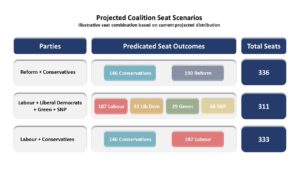
A Labour-Tory “grand coalition” in 2029 is still unlikely. But it is no longer unthinkable. The reason is not simply that British politics is becoming more fragmented, but that Reform UK’s rise is disrupting the old logic of two-party competition without yet producing a clear new governing formula. Recent YouGov polling has shown five parties clustered within single digits of each other, with Reform UK on 23%, the Greens on 21%, Labour on 18%, the Conservatives on 17% and the Liberal Democrats on 14%. That is not normal majority-government terrain. It is hung-parliament terrain, and Reform’s position at the top of that fragmented field matters most. Its rise does not simply add another party to the system; it makes a conventional Conservative path back to power more unstable, while also making any formal alignment with Reform politically risky.
That does not mean a grand coalition is popular. Quite the opposite. YouGov found in January 2026 that Britons still prefer single-party government to coalition by 49% to 27%. More importantly, Labour-Tory arrangements were the least popular of the coalition options tested: only 16-18% of Britons said they would support a “grand coalition” between the two parties, whichever leader was prime minister. So why discuss it at all? Because politics is not just about preference. It is about arithmetic, governability and risk management. If Reform’s strength is enough to prevent a stable right-of-centre bloc, but a Tory-Reform arrangement is judged too inflammatory or too costly, the space for more awkward cross-party outcomes begins to widen.
There is also the question of the political and economic terrain Britain may be facing by 2029. While right-wing populist parties currently appear to be in the ascendant in Britain and across much of the West, that picture may not hold. The economic shock triggered by the current US-Israeli war with Iran, particularly through energy prices, inflation and wider market instability, could materially alter the electoral mood. Reports show that the conflict has already pushed up oil prices sharply and prompted warnings from the IMF that it will mean slower growth and higher inflation globally. In that kind of volatile environment, voters may prove more willing to coalesce around technocratic, moderate politics, particularly if the United States itself moves back towards a Democratic administration in 2028. That would not make a grand coalition likely, but it could make the political logic behind one easier to imagine.
If the next election produces a badly fractured Commons, and if Reform has made a stable right-wing governing formula harder to construct without creating legitimacy problems of its own, Westminster could face a hard constraint: minority paralysis, repeated elections, or some form of emergency-style cross-party arrangement. In that scenario, a Labour-Tory deal would be framed not as ideological harmony, but as institutional stabilisation.
That is the strategic case. The political case is far weaker.
A grand coalition would ask voters to accept that the two parties which have structured British politics for a century are now, in effect, co-managers of the same system. At a moment when trust is already thin, that is combustible. British Social Attitudes found that only 12% trust governments to put the national interest above party interest most or all of the time, while just 19% think the system needs little or no improvement. The same study also noted that the combined Labour-Conservative vote in 2024 fell to its lowest ever level.
Public attitudes to coalition politics are also more fragile than they may first appear. Voters do not always assess multi-party arrangements by their practical consequences in advance; often, they understand them through the narratives built around them after the fact. A Conservative-Reform arrangement, for instance, could be framed as evidence that Nigel Farage had effectively dragged the Conservatives onto his terrain, just as a Labour-Liberal Democrat-Green understanding could be presented as an unstable or unrepresentative progressive stitch-up. British politics has a long history of this kind of media construction. The SDP-Liberal Alliance offers a useful example: Spitting Image repeatedly caricatured David Steel as the diminutive junior partner to David Owen, helping to frame the Alliance less as a balanced partnership than as a hierarchy in which one side had clearly lost status. The point is not that satire alone decided electoral outcomes, but that alliances are rarely judged on their formal terms. They are judged on who appears dominant, who appears diminished, and which party seems to have surrendered control of its own direction. Indeed, it is generally the junior party within coalition agreements who come off worse.
If the next election produces a badly fractured Commons, Westminster could face a hard constraint: minority paralysis, repeated elections, or some form of emergency-style cross-party arrangement.
That is where the populist danger enters. A grand coalition might steady the machinery of government, but it would also hand insurgent parties a brutally effective line of attack – they are all the same, they have stitched it up, and there is no real opposition left inside the establishment. That message would be especially potent for Reform on the right, but also for Greens or independents on the left.
The coming expansion of the electorate sharpens this further. The government has introduced legislation to lower the voting age to 16 for UK-wide elections, and the House of Commons Library says this would add roughly 1.3 million 16- and 17-year-olds in England and 48,000 in Northern Ireland based on recent estimates, with ONS labour-market statistics putting the UK-wide 16-17 population at 1.629 million in 2025. Not all would be eligible, but the bloc is still significant.
That is not to say that 16- and 17-year-olds would become such a decisive electoral bloc that they could single-handedly decide an election. However, their entrance into the electorate would reinforce a broader generational divide. The National Centre for Social Research found the Conservatives were seven points ahead among over-65s in 2024, but 35 points behind Labour among 18-24s. A system already split by age, trust and institutional legitimacy is not an ideal setting for a grand bargain at the top.
The bottom line: a Labour-Tory coalition in 2029 is still a low-probability outcome. But if fragmentation worsens, it becomes imaginable as a last-resort governing mechanism. The larger question is whether the public would see it as stability or as elite closure.
For client organisations, the implications extend well beyond party management. In a more fluid political landscape, changes in government formation can quickly translate into shifts in public sentiment, stakeholder expectations and reputational exposure. The strategic task is not only to monitor electoral outcomes, but to understand how questions of legitimacy, trust and political volatility are shaping the wider operating environment.
Read more on DRD’s Public Affairs offering